Did you know our brains can see images in just 13 milliseconds? This shows how important color is in photography. It greatly affects how we see and feel about pictures. Knowing Color Theory lets me pick the best colors to make my photos look better and touch the audience’s feelings.
The foundation of this theory is based on three main colors: red, blue, and yellow. These basic colors, and their complementary and analogous ones, create effective color schemes. Using these ideas, I can make images that are not only pretty but also stir emotions deeply.
Moreover, the RGB model helps me mix different light levels to get amazing effects. Understanding these concepts opens up a world of creativity in photo design. It helps me improve my photography greatly.
Key Takeaways
- Color significantly impacts emotional responses to images.
- The primary colors in photography are red, blue, and yellow.
- RGB color model allows for extensive color creation through varying light intensities.
- Complementary and analogous colors enhance visual interest and flow.
- Color theory is essential for improving photo aesthetics and composition.
Understanding Color Theory in Photography
Color theory is key in photography. It shapes how I compose and see my images. Grasping its basics lets me use color more skillfully, leading to both striking and cohesive photos. It involves how colors work together, how to mix them, and the emotions they can stir in viewers.
Definition and Importance
Color theory looks at how colors relate and their effects on art. Each color has meanings and feelings it can convey. Knowing this helps me send clearer messages with my photos. Hue, saturation, and brightness are all crucial. They affect how colors blend and the image’s overall feel.
The Color Wheel
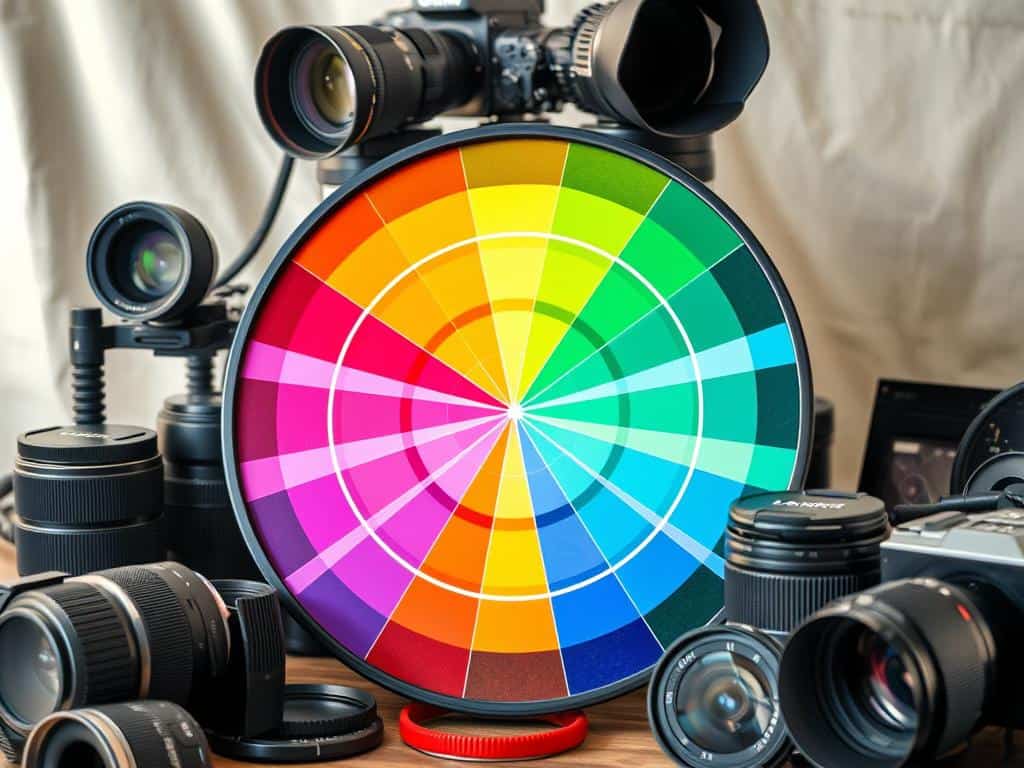
The color wheel is vital for learning about color interactions. Sir Isaac Newton created it in 1666 with twelve main colors. These include primary, secondary, and tertiary colors. Primary colors like red, yellow, and blue stand out for their brightness. They are the base of the wheel.
Mixing two primary colors gives us secondary colors, like green or orange. Tertiary colors come from combining primary and secondary ones. This gives me a broader spectrum for creative use.
Utilizing Color Schemes for Impactful Compositions
Understanding how colors work together is key in photography. The right colors can change the mood and focus of the pictures. Different color schemes, like complementary, analogous, and monochromatic, bring out different feelings.
Complementary Color Schemes
Complementary colors are opposite each other on the color wheel. Think of red and green together for high contrast. This creates interest and highlights key parts of a photo. Using these colors, pictures stand out and connect with people on an emotional level.
Analogous Color Schemes
Analogous colors sit next to each other on the wheel. Mixing colors such as blue, blue-green, and green offers a smooth blend. This creates a sense of peace and is great for calming scenes or expressive portraits. The flow of colors tells a story.
Monochromatic Color Schemes
Monochromatic color schemes focus on one color in different shades. This approach creates a unified look. Depending on the color, it can set a calm or warm mood. I find these schemes versatile yet powerful in photography.
Conclusion
Understanding color theory is key to improving my photography and storytelling. By knowing how colors work together, I can make photos that grab attention and touch hearts. Learning about different color schemes helps me highlight my message.
Exploring color relationships, saturation, and brightness lets me tell real stories through my photos. Warm colors might show excitement, while cool ones bring a sense of calm. Each photo is a chance to show ideas and feelings with color, showing its power in my story.
Using color theory principles boosts both the technique and story in my photos. Thinking about hue, saturation, and contrast, I can make impactful photos. My goal is to go beyond just looking good. I want to connect with viewers deeply.
